
Hagia Sophia: Fifteen Centuries of History in One Building
Few buildings have lived as many lives as Hagia Sophia, which has served as cathedral, mosque and museum across nearly fifteen hundred years.
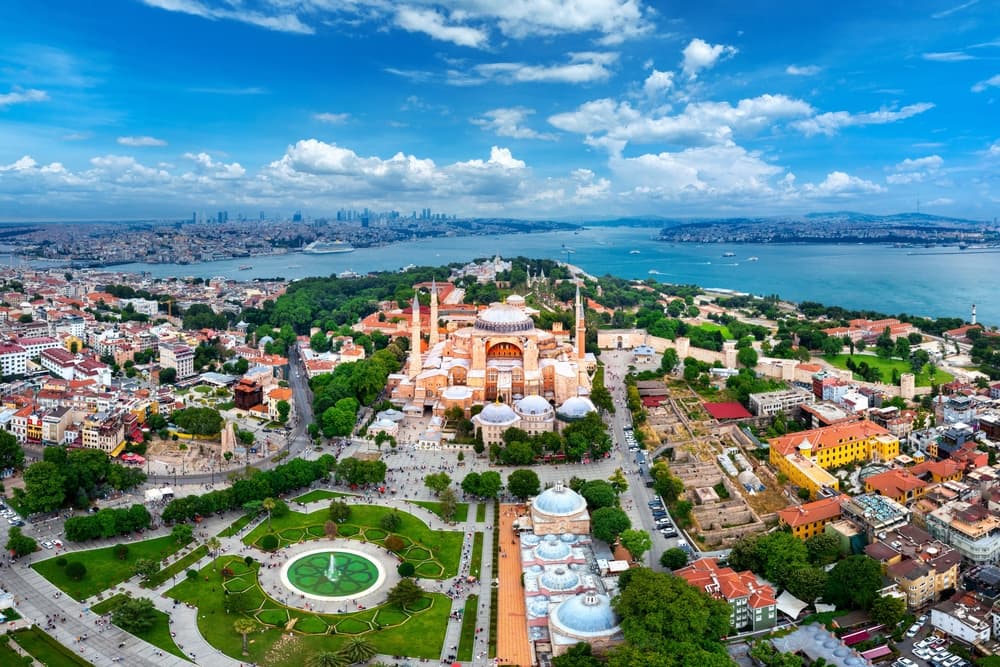
A Cathedral Born From Riot
After the Nika riots destroyed an earlier church, the Byzantine Emperor Justinian I ordered a replacement on a scale no one had attempted. Built between 532 and 537 by the physicist Isidore of Miletus and the mathematician Anthemius of Tralles, it took its Greek name from "Holy Wisdom." For close to nine hundred years it stood as the spiritual and political heart of the Byzantine Empire, hosting imperial ceremonies beneath its vast ceiling.
The standout achievement is the dome. Roughly thirty-one meters across and rising about fifty-five meters from the floor, it appears to hover thanks to pendentives that transfer its weight onto a square base. The original collapsed in part in 558 and was rebuilt by Isidore the Younger, a reminder that even genius engineering sometimes needed a second try.
Many Faiths, One Roof
In 1453 Sultan Mehmed II converted the building into a mosque, adding minarets, a mihrab, a minbar and the great green calligraphic medallions bearing the names of Allah and the Prophet. In 1935 the young Turkish Republic reopened it as a museum, and in 2020 it returned to use as a mosque. Through all of it, Byzantine mosaics and Christian iconography survive alongside the Islamic additions, which is exactly why so many people find the interior so moving.
What to Notice on a Visit
Set in the Sultanahmet district and recognized as a UNESCO World Heritage Site, Hagia Sophia rewards a slow look. Trace how the marble columns, quarried from across Anatolia and Syria, march beneath the dome, and watch the way light filters through the upper windows to soften the stone. The coexistence of Christian mosaics and Quranic panels in a single space is the detail most visitors remember long after they leave.
Because it is again an active mosque, schedule your visit around the daily prayers and dress respectfully. Arrive early in the day if you want quieter halls and clearer sightlines up into that astonishing dome.
FAQ
Can non-Muslims still visit Hagia Sophia?
Yes. Since its 2020 reconversion it functions as a working mosque, but it stays open to visitors who come to admire its architecture and history. Plan around prayer times and dress modestly, as you would for any mosque.
Why is the dome considered so remarkable?
Its builders used pendentives, curved triangular sections that let a round dome rest on a square base. The result is a thirty-one-meter dome that seems to float overhead with no visible support, an engineering leap that shaped architecture for centuries.
Has the building really changed religions more than once?
It has. Built as a Christian basilica in 537, it became a mosque after the Ottoman conquest in 1453, opened as a museum in 1935, and reverted to a mosque in 2020.